Drop A puts the low string of a guitar on an A, three and a half steps below standard E. On a six-string, that's about as far down as the instrument comfortably goes.
The tuning is simple to set up. Choosing strings and the right guitar for it is where the work is. This guide covers six-string, baritone and seven-string versions.
Drop A Tuning (Quick Answer)
On a six-string, Drop A is A E A D F# B, low to high. Strings 1 to 5 go down two and a half steps. The 6th string goes down three and a half steps, from E to A.
It's B Standard with the 6th string dropped a whole step. The bottom three strings (A, E, A) make a one-finger power chord, like every drop tuning.
On a standard-scale six-string, a standard set goes very slack here. Use the heaviest set you're comfortable with plus a much heavier low string, or move to a baritone or seven-string.
| String | Standard | Drop A | Change |
|---|---|---|---|
| 6th (thickest) | E | A | Down three and a half steps |
| 5th | A | E | Down two and a half steps |
| 4th | D | A | Down two and a half steps |
| 3rd | G | D | Down two and a half steps |
| 2nd | B | F# | Down two and a half steps |
| 1st (thinnest) | E | B | Down two and a half steps |
Good starting sets: on a baritone, our .013–.062 baritone set (S1362). On a standard-scale six-string, our .013–.056 set (S1356) with a heavier single string for the low A.
What Is Drop A Tuning?
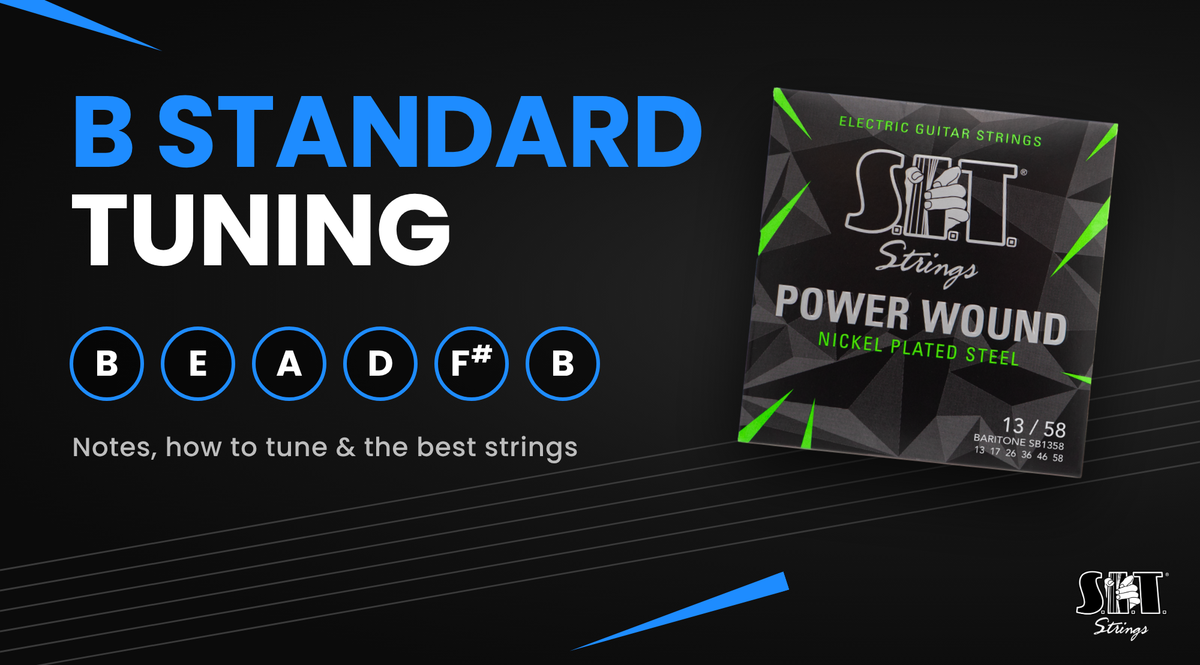
Like every drop tuning, Drop A lowers the bottom string one whole step below the rest of the guitar. Here, the rest of the guitar is in B Standard (B E A D F# B), and the 6th string drops from B to A.
You get A, E and A across the bottom three strings: root, fifth and octave. The top five strings keep standard-tuning intervals, two and a half steps lower.
Drop A on a six-string, baritone or seven-string
"Drop A" means different things depending on the guitar:
- Six-string (standard scale): A E A D F# B. Every string is a long way below where the guitar was designed to sit.
- Baritone six-string: also A E A D F# B. Our baritone sets are built for B E A D F# B, so from there Drop A only lowers the 6th string by a whole step, the same small move Drop D makes on a regular guitar.
- Seven-string: A E A D G B E. Standard seven-string tuning is B E A D G B E, so Drop A lowers only the 7th string from B to A. See drop tuning on a 7-string.
On a baritone or seven-string, Drop A is a small change. On a regular six-string, it's a big one.
Is this guide for your guitar?
This guide covers electric six-strings, baritones and seven-strings. For bass tunings in this range, see our 5- and 6-string bass guide. For other low six-string tunings, see our A Standard tuning guide and the lowest tuning for a 6-string.
How to Tune to Drop A
On a six-string or baritone:
- Tune strings 1 to 5 to B Standard with a tuner. From thinnest to thickest: B, F#, D, A, E.
- Lower the 6th string to A. Go slightly below A and tune back up so it settles at the post.
- Check it against the 5th string. Play the 6th string at the 7th fret. It should match the open 5th string (E).
- Check it against the 4th string. Sound the 12th-fret harmonic on the 6th string. It should match the open 4th string (A).
- Go around all strings again. On a standard-scale guitar, removing this much tension shifts the neck and bridge, so expect several passes.
On a seven-string, leave strings 1 to 6 in standard and lower only the 7th string from B to A. Check the 7th string at the 7th fret against the open 6th string (E).
What Drop A Changes About Your Strings
With the same gauge on the same guitar, a string loses tension as its pitch drops, and the further it drops, the more it loses. On a standard-scale six-string with an unchanged set, Drop A means:
- Strings 1 to 5: down two and a half steps, so very loose compared with standard
- 6th string: down three and a half steps, the biggest drop of any string
At that point a regular string flaps, buzzes, rings sharp on every pick attack and struggles to stay in tune.
There are two ways to get tension back: a much heavier string, or a longer scale. On a baritone, the longer scale does a lot of that work. On a seven-string, the low string is already built for B, so dropping it to A is a small step.
Does a Heavier Gauge Mean More Tension?
Only when pitch, scale length and construction stay the same. Gauge is diameter. Tension is the pull at a given pitch on a given guitar.
A .062 low A on a baritone sits at noticeably more tension than the same .062 on a 24.75" guitar, because the baritone's string is longer between the nut and saddle. Core and wrap construction affect feel too. See scale length vs string length.
A heavier string doesn't guarantee a bigger or clearer sound either. Pick attack, pickups and their height, setup and amp all shape the result. What a heavier string does is make the low A feel firmer and stay closer to pitch.
String Gauges for Drop A Compared
| Set | Gauges (high to low) | Low string | Good starting point for |
|---|---|---|---|
| S1356 .013–.056 | .013 .017 .026 .036 .046 .056 | .056 | Standard-scale six-string, with a heavier single for the low A |
| SB1358 .013–.058 (baritone) | .013 .017 .026 .036 .046 .058 | .058 | Baritones, lighter low string |
| S1362 .013–.062 (baritone) | .013 .017 .026 .036 .046 .062 | .062 | Baritones, more weight on the low A |
| S71058 .010–.058 (7-string) | .010 .013 .017 .026 .036 .046 .058 | .058 | Seven-strings with a lighter low string |
| S79564 .0095–.064 (7-string) | .0095 .013 .016 .024 .034 .046 .064 | .064 | Seven-strings with more weight on the low string |
Our baritone sets are built for B-to-B baritone tuning. We describe the S1362 as built for that tuning and for tunings below it, which includes Drop A.
How to Choose Strings for Drop A
- Confirm your guitar. Standard-scale six-string, baritone or seven-string. This decides almost everything else.
- Confirm the tuning for that guitar. A E A D F# B on six-string and baritone. A E A D G B E on seven-string.
- On a baritone or seven-string, pick by low-string feel. Choose the set with the heavier low string if you want it firmer.
- On a standard-scale six-string, go as heavy as you can play. Then add a heavier single for the low A.
- Check the nut and bridge. Very heavy strings may need wider nut slots and more saddle travel for intonation.
- Plan on a full setup. At this range, it's part of the job.
Our Drop A String Options
Power Wound Nickel Baritone .013–.062 (S1362 Baritone Custom)
Good starting point for: baritone guitars in Drop A. More weight on the low string than our standard baritone set.
- Gauges: .013 .017 .026 .036 .046 .062
- Nickel-plated steel wrap over a high carbon steel hex core
Power Wound Nickel Baritone .013–.058 (SB1358)
Good starting point for: baritone players who switch between B and Drop A and prefer a lighter low string.
- Gauges: .013 .017 .026 .036 .046 .058
Power Wound Nickel .013–.056 (S1356 Heavy)
Good starting point for: standard-scale six-strings. It's the heaviest six-string set we make. Pair it with a heavier single string for the low A.
- Gauges: .013 .017 .026 .036 .046 .056
Power Wound Nickel 7-String .010–.058 (S71058 Light)
Good starting point for: seven-strings in Drop A where you want the top six strings to feel like a regular .010 set.
- Gauges: .010 .013 .017 .026 .036 .046 .058
Power Wound Nickel 7-String .0095–.064 (S79564 Extended Range)
Good starting point for: seven-strings where you want more weight on the dropped 7th string. We built it as a light top over a very heavy low string, for tuning below B.
- Gauges: .0095 .013 .016 .024 .034 .046 .064
Building a Custom Drop A Set
On a standard-scale six-string, a custom set is often the only way to get Drop A feeling right.
- Start with a heavy set such as the .013–.056.
- Replace the 6th string with a heavier wound single for the low A.
- If the 5th string now feels loose next to it, move that up a step too.
You can buy Power Wound singles in individual gauges. See how to find a single string in a specific gauge. Very heavy strings may not fit through some bridges or tuner posts, so check before you buy.
Setup After Switching to Drop A
On a baritone or seven-string, Drop A barely changes the setup because only one string moves a whole step.
On a standard-scale six-string, plan for a full setup:
- Nut slots widened for heavier strings
- Neck relief adjusted for the new string load
- Intonation reset, often with the low saddle moved well back
- Pickup height checked, since heavy strings close to the pole pieces can pull them off pitch
See do I need a setup after switching to a lower tuning? and can pickups too close to the strings cause tuning problems?
Final Thoughts
Drop A works on a regular six-string with heavy strings, a custom low string and a careful setup. On a baritone or seven-string, it's a one-string change that the guitar is built to handle.
If you play here a lot, the guitar is the bigger decision than the strings. See our baritone tunings guide and complete guide to drop tunings.
Frequently Asked Questions
What are the notes in Drop A tuning?
On a six-string: A E A D F# B. On a seven-string: A E A D G B E.
How far down is Drop A on a six-string?
Strings 1 to 5 are two and a half steps below standard. The 6th string is three and a half steps below, from E to A.
Can you play Drop A on a regular six-string guitar?
Yes, with a heavy set, a heavier low string and a setup. Expect it to feel looser than on a baritone or seven-string.
What gauge strings do I need for Drop A?
On a baritone, our .013–.062 set. On a standard-scale six-string, our .013–.056 set plus a heavier single for the low A. On a seven-string, a 7-string set, choosing the heavier low string if you want it firmer.
Is Drop A better on a baritone?
A baritone's longer scale puts more tension on each string at the same pitch, so Drop A feels firmer and is easier to keep in tune.
What's the difference between Drop A and A Standard?
Drop A on six-string is A E A D F# B. A Standard is A D G C E A, with every string down three and a half steps. See our A Standard tuning guide.
Is Drop A lower than Drop B?
Yes, by a whole step on every string.
Why does my low A sound out of tune?
Low-tension strings go sharp when picked hard and drift more. A heavier string, a longer scale, a lighter pick attack and accurate intonation all help.
Will Drop A damage my guitar?
No. Lower tuning reduces the pull on the neck. Heavy strings bring it back up, which is a normal setup adjustment.
How do I drop tune a seven-string to A?
Lower only the 7th string from B to A. Play it at the 7th fret and match the open 6th string (E).
Can I use a 7-string set on a 6-string guitar for Drop A?
You can leave out the thinnest string and use the other six, which shifts every gauge heavier. Check that the heaviest string fits your nut, bridge and tuner post.