Half step down tuning lowers every string by one half step. Your chord shapes don't change. Everything just sounds one semitone lower.
It's the smallest move you can make from standard tuning, so the strings you already use often still work. This guide covers the notes, how to tune, and when a small gauge change is worth it.
Half Step Down Tuning (Quick Answer)
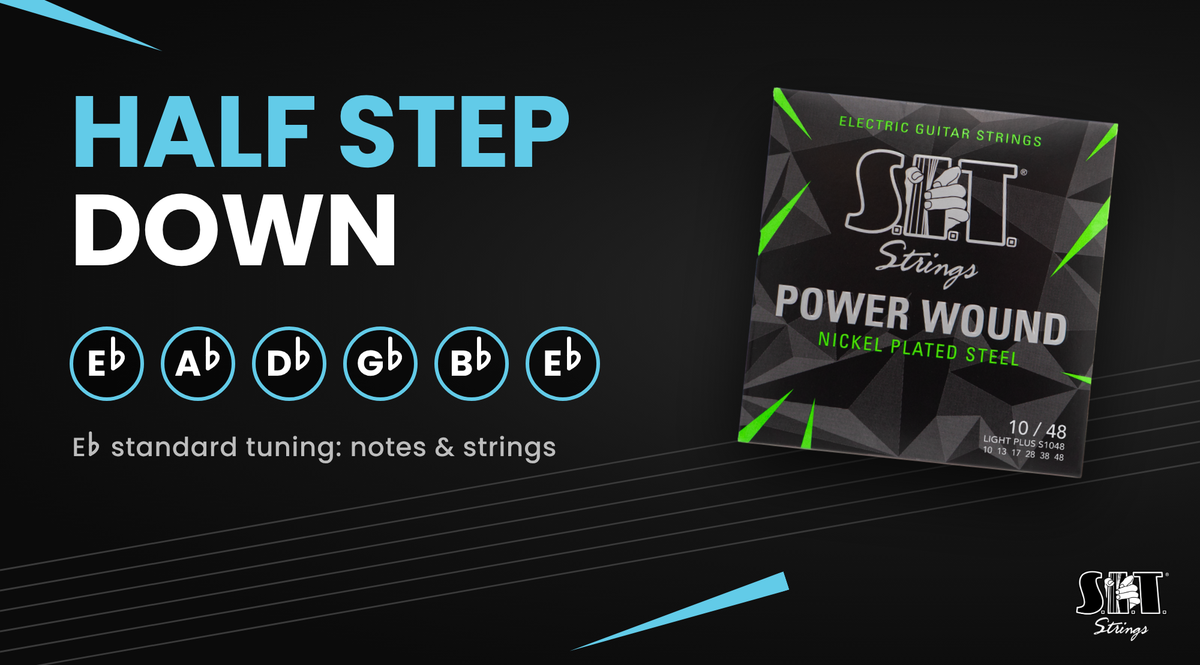
Half step down tuning is Eb Ab Db Gb Bb Eb, low to high. Every string is one half step (one semitone) below standard tuning (E A D G B E).
It's also called Eb standard, E flat tuning, or D# standard (D# G# C# F# A# D#). These are the same notes with different names.
The spacing between strings doesn't change, so every chord and scale shape works exactly as it does in standard. An E chord shape now sounds as an Eb, a G shape sounds as a Gb, and so on.
| String | Standard | Half Step Down | Change |
|---|---|---|---|
| 6th (thickest) | E | Eb | Down a half step |
| 5th | A | Ab | Down a half step |
| 4th | D | Db | Down a half step |
| 3rd | G | Gb | Down a half step |
| 2nd | B | Bb | Down a half step |
| 1st (thinnest) | E | Eb | Down a half step |
Good starting sets: your usual set is fine if you like the slightly looser feel. To get closer to your standard-tuning feel, try Power Wound .010–.048 (S1048) if you normally play .010s, or Power Wound .010–.046 (S1046) if you normally play .009s.
What Is Half Step Down Tuning?
"Standard" in a tuning name means the strings keep the same intervals as standard tuning: fourths between each pair, except a major third between the 3rd and 2nd strings. The note name tells you the lowest string.
So Eb standard is standard tuning moved down until the 6th string is an Eb. Nothing about the fretboard changes except the pitch.
Reasons to use it:
- Playing along with recordings in Eb. If a song was recorded half a step down, your standard shapes line up with it.
- Singing. Every song drops a semitone, which can put it in a more comfortable range without learning new shapes.
- A slightly looser feel. Bends and vibrato take a little less effort at the same gauge.
Half step down vs D Standard vs Drop D
- Half step down (Eb standard): Eb Ab Db Gb Bb Eb. All six strings down one semitone.
- D Standard: D G C F A D. All six strings down a whole step, one more semitone lower. See our D Standard tuning guide.
- Drop D: D A D G B E. Only the 6th string moves. See our Drop D tuning guide.
Drop Db (Drop C#)
Drop Db (also called Drop C#) is Db Ab Db Gb Bb Eb, low to high. It's the same string intervals as Drop D, with every string tuned one half step lower. Like Drop D, the bottom three strings make a one-finger power chord. For more drop tunings, see our guide to drop tunings.
Is this guide for your guitar?
- Six-string electric guitar: yes, this guide is written for you.
- Six-string acoustic guitar: yes. The tuning is the same. See the acoustic section below.
- Bass: the idea is the same (Eb Ab Db Gb on four strings), but the gauge choice is different. See strings for Eb tuning on bass.
How to Tune Half Step Down
- Tune the 6th string to Eb with a tuner. Go slightly below Eb and tune back up so the string settles at the post.
- Tune the 5th string to Ab. Play the 6th string at the 5th fret (Ab) and match the open 5th string to it.
- Tune the 4th string to Db. Play the 5th string at the 5th fret and match the open 4th string.
- Tune the 3rd string to Gb. Play the 4th string at the 5th fret and match the open 3rd string.
- Tune the 2nd string to Bb. Play the 3rd string at the 4th fret, not the 5th, and match the open 2nd string.
- Tune the 1st string to Eb. Play the 2nd string at the 5th fret and match the open 1st string.
- Go back over all six with the tuner. Lowering every string reduces the pull on the neck, so the first strings you tuned may have drifted.
Some tuners show sharps instead of flats. In that case, tune to D# G# C# F# A# D#. It's the same tuning.
Floating tremolo: lowering all six strings takes pull off the bridge, so it tilts back. Expect to go around the strings several times. If you plan to stay in Eb, the tremolo springs may need adjusting so the bridge sits where you want it.
What Half Step Down Changes About Your Strings
With the same gauge on the same guitar, lowering a string's pitch lowers its tension. A half step is a small change, smaller than going down to D Standard, but you can feel it.
What you may notice with an unchanged set:
- Bends go a little further with the same effort.
- Strings feel a little slinkier under the fingers.
- On a guitar set up with very low action, a few notes may start to buzz.
If you like that feel, keep your set. If you want your standard-tuning feel back, moving up a small step in gauge usually does it.
Does a Heavier Gauge Mean More Tension?
Only when pitch, scale length and construction are held the same. Gauge is the string's diameter. Tension is how hard it pulls at a given pitch on a given guitar.
The same set feels firmer on a 25.5" scale guitar than on a 24.75" scale guitar tuned to the same notes. A different core or wrap can also change the feel at the same gauge. See what string tension means.
We wouldn't promise that a heavier set sounds bigger or warmer in Eb. Pick attack, pickups, setup and amp all shape the sound. A heavier set mainly changes how firm the strings feel at the lower pitch. See does gauge affect tone?
String Gauges for Half Step Down Compared
| Set | Gauges (high to low) | 3rd string | Good starting point for |
|---|---|---|---|
| S942 .009–.042 | .009 .011 .016 .024 .032 .042 | Plain .016 | Keeping a very light, easy feel |
| S946 .009–.046 | .009 .011 .016 .026 .036 .046 | Plain .016 | A .009 top with firmer low strings |
| S1046 .010–.046 | .010 .013 .017 .026 .036 .046 | Plain .017 | Moving up from a .009 set |
| S1048 .010–.048 | .010 .013 .017 .028 .038 .048 | Plain .017 | A .010 player who wants a little more weight in the wound strings |
| S1052 .010–.052 | .010 .013 .017 .030 .042 .052 | Plain .017 | Switching between Eb and Drop Db |
| S1149 .011–.049 | .011 .015 .018 .028 .038 .049 | Plain .018 | A firmer feel across the set, plain 3rd for bends |
| S1150 .011–.050 | .011 .015 .020 .026 .036 .050 | Wound .020 (plain .018 option) | Moving from .010s to .011s for a firmer feel across the set |
How to Choose Strings for Half Step Down
- Confirm your guitar and tuning. Six-string guitar, every string down a half step to Eb Ab Db Gb Bb Eb.
- Note the gauge you like in standard tuning. That's your reference for feel.
- Decide whether you want the looser feel. If you do, keep your set. If you don't, move up a small step: .009s to .010s, or .010s to a .010–.048 or .011 set.
- Decide on the 3rd string. A plain 3rd bends more easily. A wound 3rd feels firmer. See plain vs wound 3rd string.
- Factor in scale length. A 24.75" guitar feels looser than a 25.5" guitar with the same set, so it may want the heavier option sooner.
- Check the setup after the change. A gauge change plus a lower tuning can call for a small truss rod or intonation tweak.
Our Half Step Down String Options
Power Wound Nickel .010–.048 (S1048 Light Plus)
Good starting point for: .010 players who want the standard .010 top with a little more weight through the wound strings.
- Gauges: .010 .013 .017 .028 .038 .048
- Nickel-plated steel wrap over a high carbon steel hex core
Power Wound Nickel .010–.046 (S1046 Light)
Good starting point for: moving up from a .009 set, or keeping your usual .010 set if you like the looser feel.
- Gauges: .010 .013 .017 .026 .036 .046
Power Wound Nickel .011–.050 (S1150 Medium Light)
Good starting point for: players moving from .010s to .011s who want a firmer feel across the set.
- Gauges: .011 .015 .020 (wound) .026 .036 .050
- Ships with a choice of 3rd string: wound .020 or plain .018
Power Wound Nickel .011–.049 (S1149 Custom Medium)
Good starting point for: a firmer set that keeps a plain 3rd string for bending.
- Gauges: .011 .015 .018 (plain) .028 .038 .049
Power Wound Nickel .010–.052 (S1052 Heavy Bottom)
Good starting point for: switching between Eb standard and Drop Db, where the 6th string drops further.
- Gauges: .010 .013 .017 .030 .042 .052
Power Groove Pure Nickel .010–.046 (PN1046 Light)
Good starting point for: the same gauges in pure nickel, which we describe as our warmer, vintage voice.
- Gauges: .010 .013 .017 .026 .036 .046
Half Step Down on Acoustic Guitar
The tuning is the same on a six-string acoustic: Eb Ab Db Gb Bb Eb. The same idea applies to gauge. Keep your set if you like the looser feel, or go up a step if you want it firmer.
- Phosphor Bronze .012–.054 (P1254 Light): our standard acoustic set, a good starting point.
- Phosphor Bronze .013–.056 (P1356 Medium): a step up, for a firmer feel at the lower pitch.
Building a Custom Half Step Down Set
If only one or two strings feel off, you don't need a new set. Swap just those strings.
For example, if your .010–.046 set feels right on top but the low Eb feels loose, replace the .046 with a .048 or .049 and leave the rest alone. You can buy Power Wound single strings and plain steel singles in individual gauges.
See can I mix strings from different sets? for more.
Setup After Switching to Half Step Down
A half step is a small change, and your guitar may play fine without any adjustment. If you also changed gauge, or your action was already very low, check a few things:
- New buzz on open strings or low frets
- Notes up the neck sounding sharp or flat compared with the open strings
- Action noticeably higher or lower than before
See how to check neck relief and how to adjust intonation after a gauge change.
Final Thoughts
Half step down keeps everything you know about the fretboard and moves it down one semitone. It's the gentlest of the lower tunings, so your current strings may be all you need.
If the strings feel too slinky, go up a small step in gauge and check the setup. If you want to go lower, D Standard is one more semitone down.
Frequently Asked Questions
What are the notes in half step down tuning?
Eb Ab Db Gb Bb Eb, from the thickest string to the thinnest.
Is Eb standard the same as D# standard?
Yes. Eb and D# are the same note. D# G# C# F# A# D# is the same tuning written with sharps.
How far down is half step down from standard tuning?
One semitone on every string, the distance of one fret.
Do chord shapes change in half step down?
No. Every shape is the same as standard tuning. Each one sounds one semitone lower.
Do I need different strings for half step down?
Not necessarily. Your usual set works, and it will feel a little looser. If you want your standard-tuning feel back, go up a small step in gauge.
What gauge should I use for half step down?
If you like your current feel, keep it. If you want it firmer, .009 players can try .010–.046, and .010 players can try .010–.048 or .011–.050.
What's the difference between half step down and D Standard?
Half step down is one semitone below standard (Eb Ab Db Gb Bb Eb). D Standard is two semitones below (D G C F A D).
What is Drop Db (Drop C#) tuning?
Db Ab Db Gb Bb Eb, low to high. It's Drop D with every string tuned one half step lower.
Will tuning half step down hurt my guitar?
Tuning a guitar down a half step generally won't harm it. Lowering the pitch reduces string tension when the gauges stay the same. If you also change gauges, check the neck relief, action and intonation afterward.
Can I tune half step down on an acoustic guitar?
Yes. Use acoustic strings, and keep your gauge or go up a step depending on how firm you want them to feel.
Can I play along with standard-tuned songs in Eb?
Not without changing the key. Everything you play sounds a semitone lower. To match a standard-tuned recording, retune, or play every shape one fret higher.
Why won't my guitar stay in tune after tuning down?
Lowering every string changes the pull on the neck and bridge, and strings take a moment to settle at the posts. Tune slightly below each note and come up to it, then go around the strings a second time. Guitars with a floating tremolo take a few more passes.