Open tunings let you strum the guitar without fretting anything and hear a chord. Many produce a major chord, which makes them especially useful for slide guitar. Others, like DADGAD, create a suspended chord with a different sound.
This guide covers the common open tunings, how to tune to each one from standard, and what they do to your strings.
Open Tunings (Quick Answer)
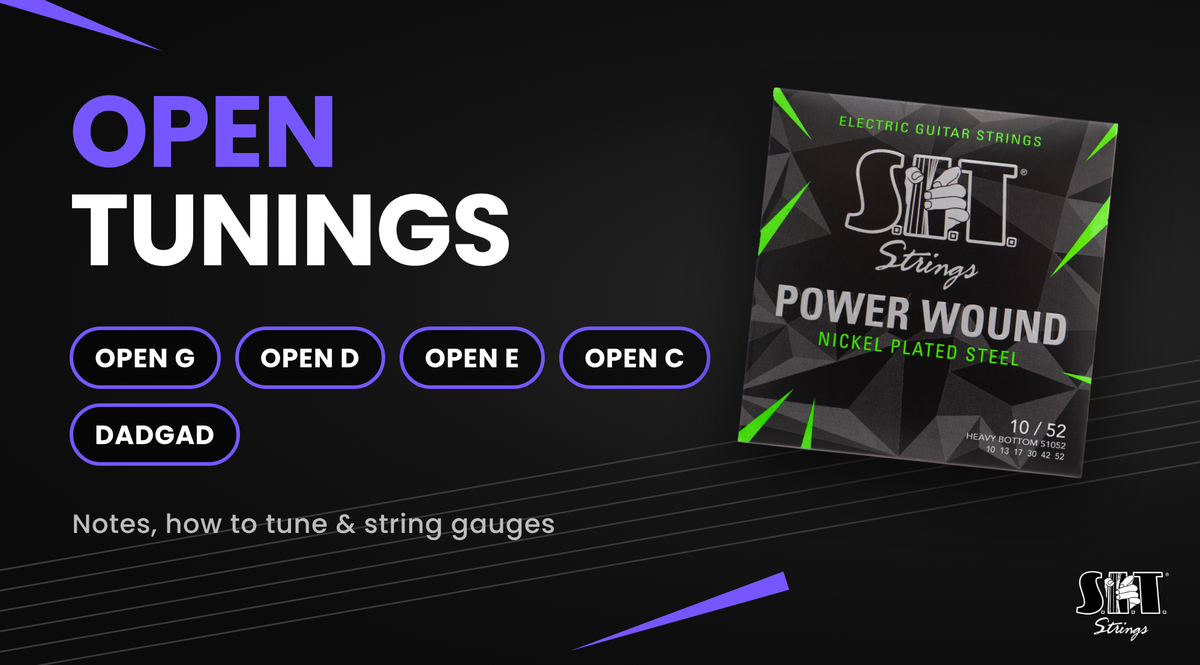
An open tuning sets the six open strings to the notes of one chord. Here are the common ones, low to high:
| Tuning | Notes (low to high) | Open chord | Strings that move from standard |
|---|---|---|---|
| Open G | D G D G B D | G major | 6th, 5th and 1st down a whole step |
| Open D | D A D F# A D | D major | 6th, 2nd and 1st down a whole step, 3rd down a half step |
| Open E | E B E G# B E | E major | 5th and 4th up a whole step, 3rd up a half step |
| Open A | E A E A C# E | A major | 4th, 3rd and 2nd up a whole step |
| Open C | C G C G C E | C major | 6th down two whole steps, 5th and 4th down a whole step, 2nd up a half step |
| DADGAD | D A D G A D | Dsus4 (not major) | 6th, 2nd and 1st down a whole step |
Tunings that lower strings (Open G, Open D, Open C, DADGAD) loosen them. Tunings that raise strings (Open E, Open A) tighten them.
Good starting sets: on electric, our .010–.052 Heavy Bottom set (S1052) for the lowered tunings. On acoustic, our .012–.056 Phosphor Bronze set (P1256).
What Is an Open Tuning?
Standard tuning (E A D G B E) is built for playing chords with fretted shapes. An open tuning retunes some strings so the guitar already plays a chord before you touch it.
That has two practical effects:
- Straight bars become chords. One finger, or a slide, across all six strings at any fret gives you a major chord in a major open tuning. That's why open tunings and slide guitar go together.
- Open strings ring under what you play. Melodies and fretted notes sit on top of droning open strings.
The trade-off is that your standard chord shapes no longer work as they are. Each open tuning has its own shapes.
"Open" tunings vs drop tunings
Drop tunings, like Drop D, lower only the bottom string so it makes a power chord with the strings above it. The rest of the guitar stays in standard. Open tunings change several strings so all six make a full chord.
Is this guide for your guitar?
- Six-string acoustic and electric guitar: yes, this guide is written for you.
- Resonator guitar: yes, for round-neck resonators. See how to tune a resonator guitar.
- Lap steel: no. Lap steel tunings like C6 and A6 are a separate family. See our lap steel tunings guide.
- Banjo: no. Five-string banjo is usually already in open G. See tuning a 5-string banjo to open G.
Open G Tuning (D G D G B D)
Lower the 6th string from E to D, the 5th from A to G and the 1st from E to D. The 4th, 3rd and 2nd stay where they are. The root note, G, sits on the 5th and 3rd strings.
Check by ear: 6th string at the 5th fret matches the open 5th (G). 5th string at the 7th fret matches the open 4th (D). 4th string at the 5th fret matches the open 3rd (G). 3rd string at the 4th fret matches the open 2nd (B). 2nd string at the 3rd fret matches the open 1st (D).
Open D Tuning (D A D F# A D)
Lower the 6th string from E to D, the 3rd from G to F# (a half step), the 2nd from B to A and the 1st from E to D. The 5th and 4th stay where they are.
Check by ear: 6th string at the 7th fret matches the open 5th (A). 5th string at the 5th fret matches the open 4th (D). 4th string at the 4th fret matches the open 3rd (F#). 3rd string at the 3rd fret matches the open 2nd (A). 2nd string at the 5th fret matches the open 1st (D).
Open E Tuning (E B E G# B E)
Open E has the same intervals as Open D, one whole step higher. Raise the 5th string from A to B, the 4th from D to E and the 3rd from G to G# (a half step). The 6th, 2nd and 1st stay where they are.
Raising three strings increases their tension. Check that your string gauges are suitable before tuning up, especially if you're using a heavier set. An alternative is to tune to Open D and put a capo at the 2nd fret. That gives you the same pitches without raising any strings.
Check by ear: 6th string at the 7th fret matches the open 5th (B). 5th string at the 5th fret matches the open 4th (E). 4th string at the 4th fret matches the open 3rd (G#). 3rd string at the 3rd fret matches the open 2nd (B). 2nd string at the 5th fret matches the open 1st (E).
Open A Tuning (E A E A C# E)
Open A has the same intervals as Open G, one whole step higher. Raise the 4th string from D to E, the 3rd from G to A and the 2nd from B to C#. The 6th, 5th and 1st stay where they are.
Raising three strings increases their tension, so check that your gauges are suitable before tuning up, especially with a heavier set. An alternative is to tune to Open G and put a capo at the 2nd fret. That gives you the same pitches without raising any strings.
Open C Tuning (C G C G C E)
Open C moves the most. Lower the 6th string from E down two whole steps to C, the 5th from A to G and the 4th from D to C. Leave the 3rd on G, raise the 2nd from B to C (a half step) and leave the 1st on E.
The low C is a long way below standard E, so this is the open tuning where a heavier low string makes the biggest difference.
Check by ear: 6th string at the 7th fret matches the open 5th (G). 5th string at the 5th fret matches the open 4th (C). 4th string at the 7th fret matches the open 3rd (G). 3rd string at the 5th fret matches the open 2nd (C). 2nd string at the 4th fret matches the open 1st (E).
DADGAD Tuning (D A D G A D)
DADGAD lowers the 6th, 2nd and 1st strings a whole step each. It isn't a major-chord tuning: the open strings make a Dsus4 chord, with G in place of the major third. That open, unresolved sound is the reason to use it.
Check by ear: 6th string at the 7th fret matches the open 5th (A). 5th string at the 5th fret matches the open 4th (D). 4th string at the 5th fret matches the open 3rd (G). 3rd string at the 2nd fret matches the open 2nd (A). 2nd string at the 5th fret matches the open 1st (D).
What Open Tunings Change About Your Strings
With the same gauge on the same guitar, a string loses tension when you tune it down and gains tension when you tune it up.
- Lowered strings (Open G, Open D, Open C, DADGAD) can feel slack, buzz, rattle under a slide and drift out of tune. Open C's low string drops the furthest.
- Raised strings (Open E, Open A) feel stiffer and are under more load. Check that your gauges suit the tuning before you tune up.
Switching back and forth also makes the guitar drift as the neck settles. Expect to retune a few times after each change.
Does a Heavier Gauge Mean More Tension?
Only when pitch, scale length and construction stay the same. Gauge is the string's diameter. Tension is how hard it pulls at a given pitch on a given guitar.
The same set feels firmer on a 25.5" scale guitar than on a 24.75" one, and core and wrap construction change the feel too. See how scale length affects gauge and feel.
We wouldn't say heavier strings make an open tuning sound bigger as a rule. Pick or finger attack, pickups, setup and the guitar itself all shape the sound. What a heavier low end reliably changes is how firm the lowered strings feel and how well they hold pitch, which matters most under a slide.
String Sets for Open Tunings Compared
| Set | Gauges (high to low) | Type | Good starting point for |
|---|---|---|---|
| S1046 .010–.046 | .010 .013 .017 .026 .036 .046 | Electric | Open E and Open A, where strings are raised |
| S1052 .010–.052 | .010 .013 .017 .030 .042 .052 | Electric | Open G, Open D and DADGAD with a familiar .010 top |
| S1150 .011–.050 | .011 .015 .020 .026 .036 .050 | Electric | Slide in open tunings, a firmer feel across the set |
| S1156 .011–.056 | .011 .014 .019 .032 .044 .056 | Electric | Trying Open C on electric |
| P1152 .011–.052 | .011 .015 .022 .032 .042 .052 | Acoustic | A lighter top with extra weight underneath |
| P1256 .012–.056 | .012 .016 .026 .036 .046 .056 | Acoustic | Open G, Open D, DADGAD and Open C on acoustic |
| P1356 .013–.056 | .013 .017 .026 .036 .046 .056 | Acoustic | The firmest feel, for staying in a lowered tuning |
How to Choose Strings for Open Tunings
- Confirm your guitar. Electric, acoustic or resonator. Each uses a different kind of set.
- Confirm whether your tuning lowers or raises strings. Open G, D, C and DADGAD lower. Open E and A raise.
- For lowered tunings, add weight to the low end. A heavy-bottom set keeps the dropped strings firm while the top stays familiar.
- For raised tunings, stay at your usual gauge or lighter, or use the lowered tuning with a capo at the 2nd fret.
- If you play slide or stay in one tuning, consider going up a gauge across the whole set.
- Fix a single loose string with a heavier single instead of changing the whole set.
Our Open Tuning String Options
Power Wound Nickel .010–.052 (S1052 Heavy Bottom)
Good starting point for: electric guitars in Open G, Open D or DADGAD, when you want the standard .010 top with more weight on the lowered bass strings.
- Gauges: .010 .013 .017 .030 .042 .052
- Nickel-plated steel wrap over a high carbon steel hex core
Power Wound Nickel .011–.050 (S1150 Medium Light)
Good starting point for: slide in open tunings, where firmer strings help keep the slide off the frets. It ships with a choice of a wound .020 or plain .018 third string.
- Gauges: .011 .015 .020 (wound) .026 .036 .050
Power Wound Nickel .011–.056 (S1156 Heavier Bottom)
Good starting point for: electric guitars experimenting with Open C. The .056 low string is heavier than our lighter sets, but if you stay in Open C you may want an even heavier single on the 6th string.
- Gauges: .011 .014 .019 (plain) .032 .044 .056
Power Wound Nickel .010–.046 (S1046 Light)
Good starting point for: Open E and Open A on electric, where three strings are tuned up.
- Gauges: .010 .013 .017 .026 .036 .046
Phosphor Bronze .012–.056 (P1256 Bluegrass)
Good starting point for: acoustic guitars in lowered open tunings. A light top with a heavy bottom.
- Gauges: .012 .016 .026 .036 .046 .056
- Phosphor bronze wrap over a high carbon steel hex core
Shop Phosphor Bronze .012–.056
Phosphor Bronze .011–.052 (P1152 Custom Light)
Good starting point for: acoustic players who want a lighter feel on top with extra weight underneath.
- Gauges: .011 .015 .022 .032 .042 .052
Shop Phosphor Bronze .011–.052
Phosphor Bronze .013–.056 (P1356 Medium)
Good starting point for: acoustic guitars kept in one lowered open tuning.
- Gauges: .013 .017 .026 .036 .046 .056
Shop Phosphor Bronze .013–.056
Resonator Nickel .017–.056 (DBR1756N)
Good starting point for: compatible resonator guitars set up for heavier strings and open tunings. Check your instrument's construction, recommended string gauges and setup before installing a heavy resonator set.
- Gauges: .017 .018 .028 .036 .046 .056
Building a Custom Open Tuning Set
Open tunings move some strings and leave others alone, so a set can feel right on four strings and loose on two. A single swap usually fixes it.
- Low string loose in Open C, G or D: go up a step or two on the 6th string.
- 1st string loose in Open G, D or DADGAD: try the next plain gauge up on the 1st string.
- Raised string feels too stiff in Open E or A: drop that string one gauge lighter, or use the capo option.
You can buy Power Wound singles, plain steel singles and Phosphor Bronze singles in individual gauges. See how to find a single string in a specific gauge.
Slide and Setup Tips for Open Tunings
- Slide: a slide rests on the strings instead of pressing them to the frets. Loose strings let it bottom out and clank. A firmer set and slightly higher action help. See what strings are best for slide guitar?
- Intonation: if you keep one guitar in an open tuning, check intonation in that tuning. See how to adjust intonation.
- Buzz on lowered strings: try a heavier string on that position, or check relief. See how to check neck relief.
- Switching often: tune each string up to pitch rather than down to it, and go around the strings a few times.
Final Thoughts
Open tunings turn the guitar into a chord before you touch it. Pick the tuning for the key and sound you want, then sort the strings: lowered tunings want a heavier low end, raised tunings want restraint or a capo.
If you only need a low bass note under standard shapes, a drop tuning is the simpler change. See our guide to drop tunings.
Frequently Asked Questions
What is an open tuning on guitar?
A tuning where the six open strings play a chord, usually a major chord, without fretting anything.
What are the notes in Open G tuning?
D G D G B D, from the thickest string to the thinnest.
What are the notes in Open D tuning?
D A D F# A D, low to high.
What are the notes in Open E tuning?
E B E G# B E, low to high.
What are the notes in Open C tuning?
C G C G C E, low to high.
Is DADGAD an open tuning?
It's usually grouped with them because the open strings ring as a chord, but the chord is Dsus4, not major.
What's the difference between Open D and Open E?
Same intervals, a whole step apart. Open E raises three strings from standard. Open D lowers four. Open D with a capo at the 2nd fret gives you Open E's notes.
Is Open E bad for my guitar?
Raising strings increases their tension, so check that your gauges are suitable before tuning up, especially with a heavier set. If you'd rather not raise strings, use Open D with a capo at the 2nd fret.
Do I need different strings for open tunings?
Not always. Many open tunings work with your regular strings, but it depends on the tuning and your current gauges. Lowered tunings may benefit from heavier strings, especially for slide. Raised tunings like Open E and Open A need more care because they increase string tension.
What strings are best for slide in open tunings?
A firmer set, like our .011–.050 on electric, helps keep the slide off the frets. For resonator guitars, check which gauges your instrument is set up for.
Which open tuning is best for slide guitar?
Open G, Open D, Open E and Open A all work well for slide because any straight bar is a major chord. Pick the key that suits the songs you play.
Can I use open tunings on an acoustic guitar?
Yes. A light-top, heavy-bottom acoustic set like our .012–.056 keeps the lowered bass strings firm.
Do I need a setup for open tunings?
Not usually for occasional use. If you keep a guitar in one open tuning or play slide, check intonation and relief, and consider slightly higher action.
Why won't my guitar stay in tune after switching to an open tuning?
Changing several strings shifts the pull on the neck, and lowered strings settle slowly. Tune each string up to pitch and go around the strings a few times.