B Standard takes every string down two and a half steps. Your chord shapes don't change. Everything sounds a fourth lower.
It's a common baritone tuning and a big drop for a regular six-string. This guide covers the notes, how to tune, and which of our sets to start with on each.
B Standard Tuning (Quick Answer)
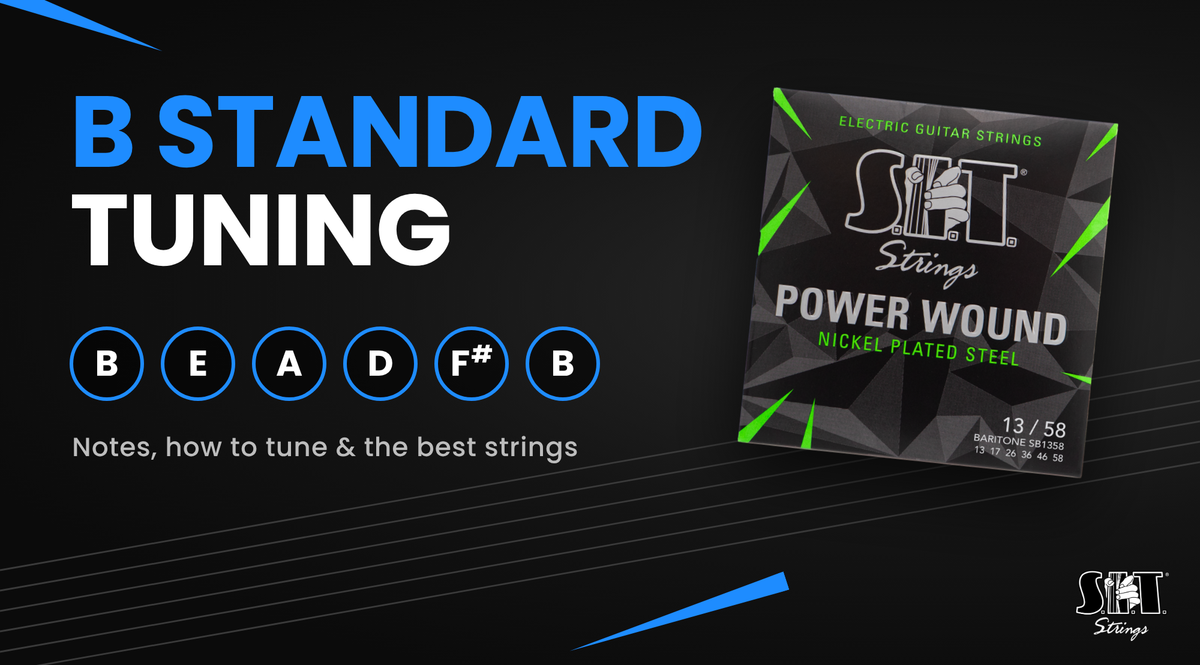
B Standard tuning is B E A D F# B, low to high. Every string is two and a half steps (five semitones) below standard tuning (E A D G B E).
The spacing between strings doesn't change, so every chord and scale shape works exactly as it does in standard. An E chord shape now sounds as a B, an A shape sounds as an E, and so on.
On a baritone designed around B-to-B tuning, B Standard is the tuning it's set up for. On a standard-scale six-string, it's a big drop, and the strings need to be much heavier than a usual set.
| String | Standard | B Standard | Change |
|---|---|---|---|
| 6th (thickest) | E | B | Down two and a half steps |
| 5th | A | E | Down two and a half steps |
| 4th | D | A | Down two and a half steps |
| 3rd | G | D | Down two and a half steps |
| 2nd | B | F# | Down two and a half steps |
| 1st (thinnest) | E | B | Down two and a half steps |
Good starting sets: on a baritone, our .013–.058 baritone set (SB1358) is a natural starting point. On a standard-scale six-string, B Standard typically requires considerably heavier strings than standard tuning. Our .013–.056 set (S1356) can serve as a starting point for building a custom set, but you may need heavier gauges across multiple strings, not just the low B.
What Is B Standard Tuning?
"Standard" in a tuning name means the strings keep the same intervals as standard tuning: fourths between each pair, except a major third between the 3rd and 2nd strings. The letter names the lowest string.
B Standard is standard tuning moved down until the 6th string is a B. Five semitones is a perfect fourth, so everything you play sounds a fourth below the same shape in standard tuning.
You can read the same tabs and chord charts. The music just comes out lower.
B Standard vs Drop B
Both tunings have a low B, which is why they get mixed up:
- B Standard: B E A D F# B. Every string down two and a half steps.
- Drop B: B F# B E G# C#. Strings 1 to 5 down a step and a half, the 6th down two and a half. See our Drop B tuning guide.
In B Standard, chord shapes match standard tuning. In Drop B, the bottom three strings make a one-finger power chord. B Standard is also lower overall: strings 1 to 5 sit a whole step below their Drop B counterparts.
B Standard vs a seven-string
Standard seven-string tuning is B E A D G B E, low to high. Its four lowest strings match the four lowest strings of six-string B Standard (B E A D). The remaining notes differ, so the two instruments don't share the same tuning across all strings.
Is this guide for your guitar?
- Baritone guitar: yes. B Standard is a common baritone tuning, particularly on guitars designed around B-to-B tuning. Check your instrument's recommended tuning and string gauges. See how a baritone guitar is tuned.
- Standard-scale six-string (24.75" to 25.5"): yes, with heavy strings and a setup. Expect it to feel looser than on a baritone.
- Seven-string: no. Its usual tuning is different (see above). See strings for 7- and 8-string guitars.
- Bass: no. A bass sits an octave lower. See our 5- and 6-string bass guide for low B on bass.
How to Tune to B Standard
- Tune the 6th string to B with a tuner. Go slightly below B and tune back up so the string settles at the post.
- Tune the 5th string to E. Play the 6th string at the 5th fret (E) and match the open 5th string.
- Tune the 4th string to A. Play the 5th string at the 5th fret and match the open 4th string.
- Tune the 3rd string to D. Play the 4th string at the 5th fret and match the open 3rd string.
- Tune the 2nd string to F#. Play the 3rd string at the 4th fret, not the 5th, and match the open 2nd string.
- Tune the 1st string to B. Play the 2nd string at the 5th fret and match the open 1st string.
- Go back over every string with a tuner. Taking this much pull off the neck makes the strings you tuned first drift. Expect several passes, more with a floating tremolo.
From D Standard: lower every string a step and a half. D to B, G to E, C to A, F to D, A to F#, D to B.
On a baritone set up for B-to-B tuning: tune each string to B E A D F# B.
What B Standard Changes About Your Strings
With the same gauge on the same guitar, a string loses tension as its pitch drops, and the further it drops, the more it loses. In B Standard, all six strings drop two and a half steps.
On a standard-scale six-string with a set built for standard tuning, you may notice:
- Strings that feel slack and move a lot when picked
- Notes that pull sharp when you pick or fret hard
- Fret buzz across much of the neck
There are two ways to get the feel back: much heavier strings, or a longer scale. A baritone's longer scale does much of that work, which is why B Standard suits many baritones and is a big step on a regular guitar.
Does a Heavier Gauge Mean More Tension?
Only when pitch, scale length and construction stay the same. Gauge is the string's diameter. Tension is how hard it pulls at a given pitch on a given guitar.
The same .058 low B feels firmer on a 28" baritone than on a 25.5" guitar, because the string is longer between the nut and saddle. Core shape and wrap material change the feel too. See scale length vs string length.
We wouldn't say a heavier set makes B Standard sound bigger or darker as a rule. Pick attack, pickups and their height, setup and amp settings all shape the sound. What a heavier set reliably changes is how firm the strings feel and how well they hold pitch at this tuning.
String Gauges for B Standard Compared
| Set | Gauges (high to low) | Low string | Good starting point for |
|---|---|---|---|
| Reverend 11.5–56 (baritone) | .0115 .016 .019 .034 .046 .056 | .056 | Baritones, a lighter feel with a plain 3rd |
| SB1358 .013–.058 (baritone) | .013 .017 .026 .036 .046 .058 | .058 | Baritones in B Standard |
| S1362 .013–.062 (baritone) | .013 .017 .026 .036 .046 .062 | .062 | Baritones, more weight on the low B |
| Reverend 12–68 (baritone) | .012 .018 .026 .040 .052 .068 | .068 | Baritones, the most weight on the low strings |
| S1254 .012–.054 (six-string) | .012 .016 .022 .032 .042 .054 | .054 | Standard-scale six-strings, as a base for a custom set |
| S1356 .013–.056 (six-string) | .013 .017 .026 .036 .046 .056 | .056 | Standard-scale six-strings, the heaviest six-string set we make |
We describe the SB1358 as our standard baritone set, built for baritone tuning, B to B, and the S1362 as our heavier baritone set, for B and the tunings below it.
How to Choose Strings for B Standard
- Confirm your guitar. Baritone or standard-scale six-string. This decides almost everything else.
- Confirm the tuning. B E A D F# B on six strings. If you play a seven-string, see the seven-string section above.
- On a baritone, pick by low-string feel. The .058 for our standard baritone feel, the .062 for a firmer low B, the 12–68 for the most weight across the bottom strings.
- On a standard-scale six-string, plan on a custom set. Every string drops five semitones, so you may need heavier gauges on several strings, not just the low B.
- Check the nut, bridge and tuner posts. Very heavy strings may need wider nut slots and more saddle travel.
- Plan on a setup. At this range on a standard-scale guitar, it's part of the job.
Our B Standard String Options
Power Wound Nickel Baritone .013–.058 (SB1358 Baritone)
Good starting point for: baritone guitars in B Standard.
- Gauges: .013 .017 .026 (wound) .036 .046 .058
- Nickel-plated steel wrap over a high carbon steel hex core
Power Wound Nickel Baritone .013–.062 (S1362 Baritone Custom)
Good starting point for: baritones where you want more weight on the low B, or you also tune below B.
- Gauges: .013 .017 .026 (wound) .036 .046 .062
Reverend Signature Baritone 11.5–56
Good starting point for: baritones where you want a lighter feel and a plain 3rd string. We developed it with Reverend Guitars for their Pete Anderson PA3 baritone.
- Gauges: .0115 .016 .019 (plain) .034 .046 .056
Reverend Signature Baritone 12–68
Good starting point for: baritones where you want the bottom three strings as firm as possible.
- Gauges: .012 .018 .026 (plain) .040 .052 .068
Power Wound Nickel .013–.056 (S1356 Heavy)
Good starting point for: standard-scale six-strings, as a base for a custom set. It's the heaviest six-string set we make. B Standard is a big drop, so you may need heavier gauges across multiple strings, not just the low B.
- Gauges: .013 .017 .026 (wound) .036 .046 .056
Power Wound Nickel .012–.054 (S1254 Med-Heavy)
Good starting point for: standard-scale six-strings where you want a plain 3rd string and a slightly lighter top than the .013 set.
- Gauges: .012 .016 .022 (plain) .032 .042 .054
Building a Custom B Standard Set
On a standard-scale six-string, a custom set is often how B Standard ends up feeling right.
- Low B still loose: start with the .013–.056 and replace the 6th string with a heavier wound single, such as a .060 or .062.
- 5th string now feels loose next to it: move it up a step too.
- Another route: use a baritone set's gauges on your six-string, if they fit your nut, bridge and tuners. That gives you more weight across the whole set, not just the low string.
You can buy Power Wound singles and plain steel singles in individual gauges. See how to find a single string in a specific gauge. Very heavy strings may not fit through some bridges, nut slots or tuner posts, so check before you buy.
Setup After Switching to B Standard
On a baritone set up for B-to-B tuning, B Standard is what it's already set up for. If you're putting on a new gauge, check string feel, neck relief, action and intonation after it settles.
On a standard-scale six-string, plan for a full setup:
- Nut slots widened for heavier strings
- Neck relief adjusted for the new string load
- Intonation reset, often with the low saddles moved back
- Pickup height checked, since heavy strings close to the pole pieces can pull notes off pitch
See do I need a setup after switching to a lower tuning? and can pickups too close to the strings cause tuning problems?
Final Thoughts
B Standard keeps every shape you know and drops it a fourth. On many baritones, it's the tuning they're set up for. On a regular six-string, it takes considerably heavier strings, often a custom set, plus a setup.
If you play here often, the guitar matters as much as the strings. See our baritone tuning guide. If you want to go lower still, see A Standard. If you only need the low B for riffs, compare Drop B.
Frequently Asked Questions
What are the notes in B Standard tuning?
B E A D F# B, from the thickest string to the thinnest.
How far down is B Standard?
Two and a half steps, or five semitones, on every string. That's a perfect fourth below standard.
Is B Standard the same as Drop B?
No. Drop B is B F# B E G# C#. Only the lowest string matches.
Which is lower, B Standard or Drop B?
B Standard. Both have the same low B, but strings 1 to 5 are a whole step lower in B Standard.
Is B Standard the same as seven-string tuning?
No. Standard seven-string tuning is B E A D G B E. Its four lowest strings match the four lowest strings of six-string B Standard (B E A D), but the remaining notes differ.
Is B Standard a baritone tuning?
Yes. It's a common baritone tuning, particularly on guitars designed around B-to-B tuning. Check your instrument's recommended tuning and gauges.
Can I play B Standard on a regular six-string?
Yes, with considerably heavier strings (often a custom set) and a setup. It will feel looser than on a baritone.
What gauge strings should I use for B Standard?
On a baritone, our .013–.058 baritone set is a natural starting point. On a standard-scale six-string, our .013–.056 set can be the base for a custom set, with heavier gauges on several strings.
Can I use .010 strings in B Standard?
You can tune them there, but they'll be very slack, buzz and pull sharp. A much heavier set is worth it at this pitch.
Do chord shapes change in B Standard?
No. They're identical to standard tuning and sound a fourth lower.
Will B Standard damage my guitar?
Lowering the pitch reduces string tension when the gauges stay the same, so the tuning itself generally won't harm a guitar. Switching to much heavier strings can call for adjustments to the nut, bridge, neck relief and the rest of the setup, so check that the gauges fit your instrument before installing them.
Why won't my guitar stay in tune in B Standard?
Strings that are too light for B Standard can fluctuate in pitch when picked or fretted. Check that your gauges are appropriate for the tuning, tune up to each note, and inspect the nut, bridge and overall setup. A longer scale or heavier strings can help improve pitch stability.