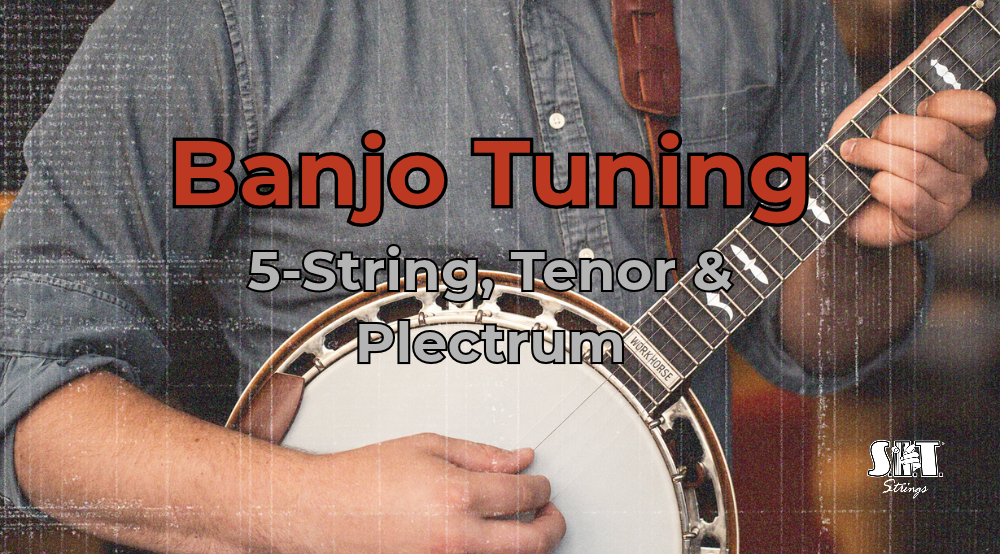
Banjo tuning looks confusing at first because of that short 5th string. Once you know which string is which, it's quick to tune and easy to check by ear.
This guide covers standard 5-string tuning, the other 5-string tunings you'll run into, tenor and plectrum banjo tuning, and which of our sets fit each.
Banjo Tuning (Quick Answer)
Standard 5-string banjo tuning is open G: g D G B D, from the 5th string to the 1st. Strummed open, the strings make a G major chord.
| Banjo | Standard tuning | Written |
|---|---|---|
| 5-string | Open G | g D G B D (5th to 1st) |
| Tenor (4-string) | Standard tenor | C G D A (low to high) |
| Tenor, Irish | Irish tenor | G D A E (low to high) |
| Plectrum (4-string) | Standard plectrum | C G B D (low to high) |
The lowercase g marks the short 5th string, tuned to a high G.
How the 5-String Banjo Is Strung
The 5th string is the odd one. It's short, starts at the 5th fret with its own tuning peg on the side of the neck, and is tuned higher than any other open string. It sits on the bass side of the neck but plays a high drone.
| String | Note | Where it sits |
|---|---|---|
| 5th (short) | High G | Bass side, starts at the 5th fret |
| 4th | D (lowest note) | Thickest full-length string |
| 3rd | G | Middle |
| 2nd | B | Middle |
| 1st | High D | Thinnest full-length string, nearest the floor |
The 1st string is an octave above the 4th, and the 5th string is an octave above the 3rd. See what is the string order on a 5-string banjo?
Is this guide for your banjo?
- 5-string banjo: yes.
- Tenor and plectrum banjos (4-string): yes, see their own sections below. They take different sets from each other and from a 5-string.
- 6-string banjo (banjo guitar): no. It's tuned like a guitar, E A D G B E. See our standard guitar tuning guide.
- Banjo ukulele: no. It's tuned like a ukulele. See how do I tune a ukulele?
Not sure which you have? Count the strings. Five strings with one short one is a 5-string. Four strings on a shorter neck is usually a tenor. Four strings on a full-length neck, like a 5-string without the short string, is a plectrum.
How to Tune a 5-String Banjo to Open G
With a tuner:
- Clip a tuner on the headstock and set it to A = 440 Hz.
- Tune the 3rd string to G.
- Tune the 4th string to D, then the 2nd to B and the 1st to D.
- Tune the 5th string to G. It's an octave above the 3rd.
- Go around again. Tightening strings pulls on the head and neck, so the others shift.
Always tune up to the note. If you go past it, drop below and come back up.
By ear, once the 3rd string is on G:
- 4th string at the 5th fret matches the open 3rd string (G).
- 3rd string at the 4th fret matches the open 2nd string (B).
- 2nd string at the 3rd fret matches the open 1st string (D).
- 1st string at the 5th fret matches the open 5th string (G).
Because the banjo's bridge floats, a big tuning change can shift it. Check that the bridge still stands straight after tuning. See how do I tune a 5-string banjo to open G?
Other 5-String Banjo Tunings
Open G is the standard. Each of these other tunings is a small change from it:
| Tuning | Notes (5th to 1st) | Change from open G |
|---|---|---|
| Open G | g D G B D | None |
| Double C | g C G C D | 4th string down a whole step to C, 2nd string up a half step to C |
| G modal (Sawmill) | g D G C D | 2nd string up a half step to C |
| Drop C (C tuning) | g C G B D | 4th string down a whole step to C |
| Open D | f# D F# A D | 5th down to F#, 3rd down to F#, 2nd down to A |
How to retune from open G
- Double C: lower the 4th string to C, then raise the 2nd to C. Check the 4th string: at the 7th fret it matches the open 3rd (G). Check the 2nd string: at the 2nd fret it matches the open 1st (D).
- G modal: raise only the 2nd string to C. Check: the 2nd string at the 2nd fret matches the open 1st (D).
- Drop C: lower only the 4th string to C.
- Open D: lower the 5th and 3rd strings a half step to F#, and the 2nd a whole step to A.
Lowering a string loosens it. If the 4th string feels floppy in double C, a slightly heavier 4th string helps.
How to Tune a Tenor Banjo
Standard tenor tuning is C G D A, low to high, all in fifths. That's the same notes as a viola.
- Tune the 3rd string to G.
- Tune the 4th string to C. At the 7th fret it should match the open 3rd (G).
- Tune the 2nd string to D. The 3rd string at the 7th fret should match it.
- Tune the 1st string to A. The 2nd string at the 7th fret should match it.
Irish tenor tuning is G D A E, low to high, an octave below the violin. Each string is tuned a perfect fourth below standard C G D A. That drops the tension a lot, so use heavier gauges chosen for G D A E rather than loosening a C G D A set. Check scale length and nut-slot fit before switching. See how do I tune a tenor banjo?
How to Tune a Plectrum Banjo
Standard plectrum tuning is C G B D, low to high. It's a 5-string's tuning without the short string, with the 4th string lowered from D to C.
- Tune the 3rd string to G.
- Tune the 4th string to C. At the 7th fret it should match the open 3rd (G).
- Tune the 2nd string to B. The 3rd string at the 4th fret should match it.
- Tune the 1st string to D. The 2nd string at the 3rd fret should match it.
See how do I tune a plectrum banjo?
What Our Banjo Strings Are Made Of
- Wound strings: stainless steel over a high carbon steel hex core. We describe the sound as bright and clear, with plenty of attack.
- Ends: loop end throughout. See are banjo strings loop end or ball end?
Why stainless on banjo?
Stainless steel resists corrosion and has a bright voice that suits the banjo's drum-like head. If you'd rather have a warmer wound string, we also make nickel wound banjo singles.
5-String Banjo Gauges Compared
| String | Note | B5920 Light | B51024 Medium |
|---|---|---|---|
| 1st | D | .009 | .010 |
| 2nd | B | .010 | .013 |
| 3rd | G | .013 | .015 |
| 4th | D | .020 wound | .024 wound |
| 5th | g | .009 | .010 |
Good starting point for:
- B5920 Light: an easier feel when fretting and picking.
- B51024 Medium: a firmer feel under the fingers.
Does a Heavier Gauge Mean More Tension?
Only when pitch, scale length and construction stay the same. On the same banjo in the same tuning, the Medium set is under more tension than the Light set. Retune to double C and the 4th string loosens on either set.
Gauge isn't the only thing that shapes a banjo's sound. Head tension, the bridge, the tone ring and your picking all change it. We wouldn't reduce it to a rule that heavier is louder. What gauge changes reliably is feel.
How to Choose Banjo Strings
- Confirm your banjo type. 5-string, tenor or plectrum. Each takes its own set.
- Confirm the tuning you play most. Open G, double C, CGDA or Irish GDAE.
- Choose the feel. Light for easier fretting, Medium for firmer.
- Check the bridge after a change. A new gauge can shift the bridge and intonation.
- Use singles for tuning-specific tweaks. A heavier 4th string for double C, for example.
Our Banjo String Options
Banjo Strings .009–.020 (B5920 Light)
Good starting point for: 5-string players who want an easier feel.
- Gauges: .009 .010 .013 .020w, with a .009 5th string
- Stainless steel wound, loop end
Banjo Strings .010–.024 (B51024 Medium)
Good starting point for: 5-string players who want a firmer feel. Our standard 5-string set.
- Gauges: .010 .013 .015 .024w, with a .010 5th string
- Stainless steel wound, loop end
Tenor Banjo Strings .011–.028 (TB41128)
Good starting point for: tenor banjos in standard C G D A tuning.
- Gauges: .011 .014 .024w .028w
- Stainless steel wound, loop end
Plectrum Banjo Strings .011–.026 (PB41126)
Good starting point for: plectrum banjos in C G B D tuning.
- Gauges: .011 .014 .017 .026w
- Stainless steel wound, loop end
Custom Banjo Sets and Singles
We sell loop end banjo singles in stainless wound and nickel wound, so you can change one string without buying a set.
- Double C or drop C: a slightly heavier 4th string keeps the low C from feeling loose.
- Irish GDAE tenor: heavier strings across the set, since every string sits a fourth lower. Check your nut slots first.
- A warmer wound string: swap in a nickel wound 4th.
Restringing and Bridge Care
A banjo bridge isn't glued down. String pressure holds it in place, so:
- Change one string at a time so the bridge stays put.
- Check the bridge after tuning. It should stand straight, not lean toward the neck or tailpiece.
- Check intonation. Compare the fretted note at the 12th fret with the 12th-fret harmonic. If they differ, the bridge position or another part of the setup may need adjustment.
- Change strings when they stop holding pitch, sound dull or show corrosion.
See how do I restring a banjo?
Final Thoughts
Learn g D G B D and where the short 5th string fits, and 5-string banjo tuning stops being confusing. Double C, G modal and drop C each change only one or two strings from open G, and open D changes three, so they're easy to explore once you know the standard tuning.
Tenor and plectrum banjos are their own instruments with their own tunings and sets. Confirm which banjo you have, then choose the feel you like.
Frequently Asked Questions
What is standard 5-string banjo tuning?
Open G: g D G B D, from the 5th string to the 1st.
Why is the 5th string short?
It's a drone string. It starts at the 5th fret and rings a high G against what you play on the other strings.
Which banjo string is the highest?
In open G, the short 5th string (high G) is the highest open note, even though it sits on the bass side of the neck.
What is double C tuning on banjo?
g C G C D. Lower the 4th string from D to C and raise the 2nd string from B to C.
What is tenor banjo tuning?
C G D A, low to high. Irish tenor is G D A E.
What is plectrum banjo tuning?
C G B D, low to high.
Are tenor and plectrum banjo strings the same?
No. They have different scale lengths and tunings, so we make separate sets.
Can I use guitar strings on a banjo?
Ball-end guitar strings may not fit a loop-end tailpiece, and the gauges don't match a banjo's tuning. See can I use guitar strings on a mandolin or banjo?
Are banjo strings loop end or ball end?
All our banjo sets are loop end. Check your tailpiece before ordering.
Do I need different strings for double C?
No. Your open G set works. A slightly heavier 4th string can make the low C feel firmer.
Why does my banjo go out of tune when I change tunings?
Changing one string shifts the pull on the head, neck and bridge, so the others move a little. Retune all five after any change.
Can I use a 5-string set on a plectrum banjo?
Not as a substitute. A plectrum set is gauged for C G B D on a full-length neck with no drone string. Use our PB41126.